The AI Migration Nightmare
The hardest part of AI has nothing to do with the model. Here is the brutal truth about your data - and why getting it clean is the most valuable work your team can do.
There is a question every organisation faces when they get serious about AI. The honest answer is almost always embarrassing.
What state is your existing data actually in?
We had fourteen years of Collab365 content. Thousands of posts, course transcripts, tutorials, and articles.
It lived inside WordPress. It lived inside a legacy platform called Circle. It was written in all eras of our brand, embedded with dead shortcodes, and packed with HTML structures that would make a modern engineer weep.
The Statistics Nobody Wants to Publish
This is not unique to us. A comprehensive analysis by MIT and Snowflake found that 78% of businesses lack the clean data foundation required to support generative AI.MIT / Snowflake
Nearly four out of five companies wanting an AI Copilot have data that makes the Copilot dangerously unreliable. They just have not realised it yet.
60% of AI projects lacking AI-ready data are predicted to be abandoned before 2026 ends.Gartner The data foundation is the real blocker. Not the model. Not the prompt. The data.
Right now, seven out of ten engineers are wasting hours every single day just cleaning up data messes created by systems that were never designed to talk to each other.
Do You Have This Blocker?
Here is a quick test. If you pointed an AI at your internal knowledge base today - your Confluence wiki, your SharePoint intranet, your WordPress blog, your shared Google Drive - and a client asked a technical question, would you trust what came back?
If your content spans more than three years, lives across more than two platforms, and has been created by more than one person, your data is almost certainly not AI-ready. That is not a criticism. It is the honest state of 78% of organisations right now. Ours included.
Why Messy Data Is Not Just an IT Blocker
Feed an LLM contradictory, outdated content, and it does something deeply counterintuitive.
It doesn't refuse to answer. It confidently synthesises everything into an authoritative-sounding response. It blends accurate truths with outdated nonsense and presents the result as pure fact.
Because organisations are strictly liable for the outputs of their AI tools, the state of your data is not just an IT department blocker. It is a commercial bomb sitting on the CEO's desk.
The "Oh My God" Migration Moment
I remember staring at our database schema at midnight on a Friday and realizing we were in serious trouble.
We didn't just have a legacy archive. We had a sprawling, seven-site horror show.
We had Thrive Themes pumping out thousands of lines of bloated HTML logic. We had legacy communities in Circle. We had a Daily Digest generated by an early LLM running over RSS feeds, sitting inside an entirely separate WordPress install.
We had our main blog. A secondary powerplatformer.com blog. A custom-coded URL shortener holding years of conference session links.
Tens of thousands of disjointed pages.
If you point an AI directly at that kind of mess, it chokes.
Vibe-coding the new Collab365 Spaces platform from scratch took weeks. The migration scripts took longer. And the sheer scale of the extraction was brutal.
We had a strict, unbreakable rule: Do not conduct the migration on live data. Everything had to be done safely and completely offline between a copy of the legacy system and the new staging environment.
So how do you safely drag fourteen years of bloated internet history into a clean, modern infrastructure? You do not hand-crank the migration. You use AI.
Because our AI agent, Antigravity, had access to both our local development environment (the destination architecture) and a replica of our database (the source records), it had Dual-Sight. It could see both sides of the bridge simultaneously.
Here is the exact playbook we used to safely migrate our entire business using AI, without losing a single SEO ranking:
- The Catalog Audit. Before moving a single byte, we mapped the disaster. We audited our legacy data catalogs, documented exactly what tables did what, and stored that architectural map inside Antigravity's permanent memory. The AI now understood our history.
- The Purge Plan. Fourteen years of data contains a lot of garbage. We used the AI to help classify exactly what needed to be archived for compliance, what could be consolidated, and what needed to be permanently deleted before it polluted the new system.
- The URL Contract. This is where 90% of migrations fail. Before touching any data, we used the AI to rigorously map every legacy slug to its future destination. If we broke those links, we would destroy over a decade of Google indexing and wipe out user bookmarks. The redirect map was locked in first.
- The Autonomous Scripts. Because Antigravity could "see" both the source database schema and our pristine new Service Layer, we instructed it to write the extraction scripts. It wrote brutal, sequential RegEx scripts to strip out the legacy HTML noise so the new AI architecture would not drown in tags.
- The Destination Tests. With the scripts running against our local copy, the AI then wrote automated tests in the destination environment. It natively verified that the mapped data had successfully landed in the pristine structural format we demanded.
- The Modernization Layer. We did not just blindly copy old data; we weaponized it. We built a custom AI-enabled web editor. It took legacy session transcripts from 2018, generated deep research prompts, and automatically rewrote the solutions for the reality of 2026 before saving them into the new architecture.
- The Human Verification. AI sped up the migration massively. It wrote the scripts, mapped the URLs, and stripped the HTML. But we could never let it deploy blindly. The final testing was intensely human. We eyeballed the output manually. We tested the local copy. We held our breath. And then we pushed it live.
The Markdown Reality (And Why It Matters)
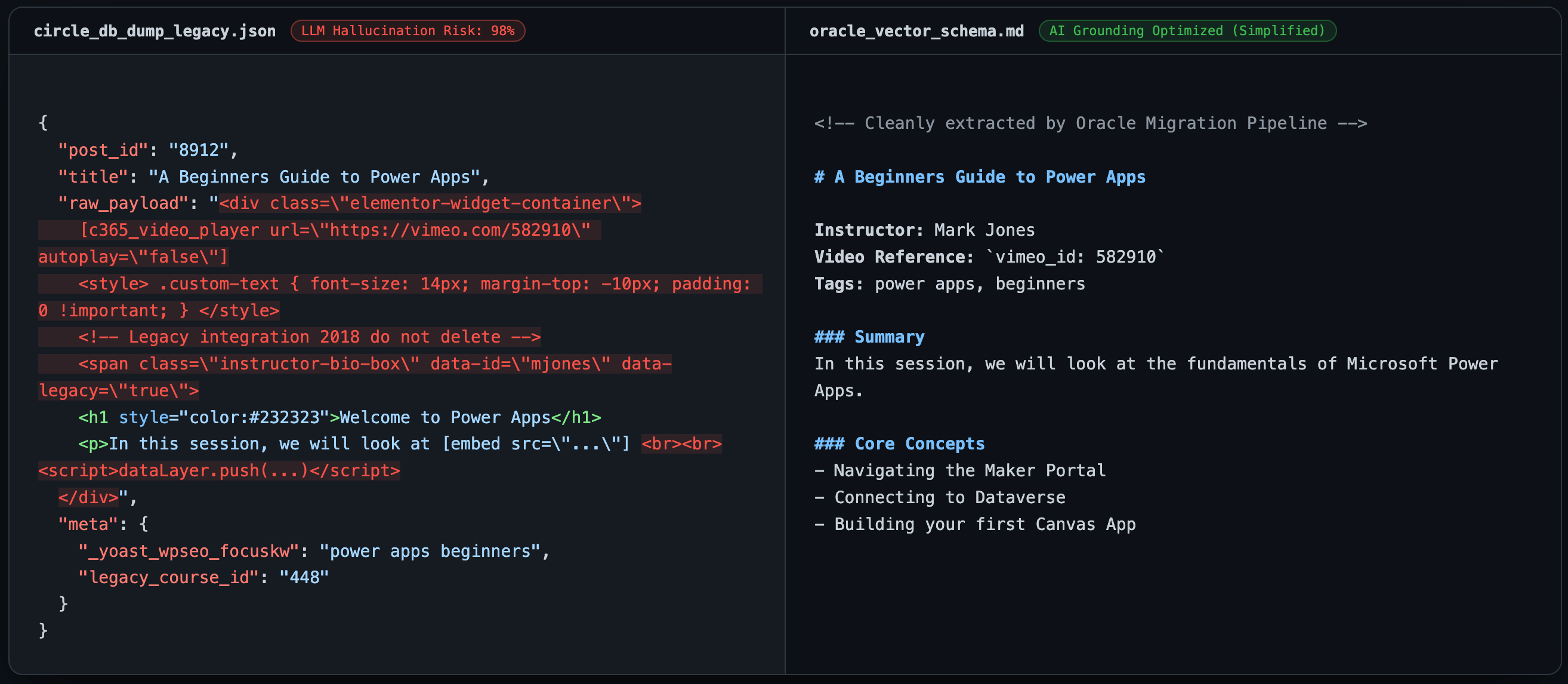
There is one final, critical piece to this architecture. While we used traditional database columns for standard metadata, the actual core content of our platform (the transcripts, the lessons, the blocker summaries) was migrated exclusively into a format called Markdown.
To a non-technical user, Markdown is simply a clean, stripped-back way of writing text without any bloated formatting code attached to it. But to an AI, Markdown is oxygen.
AI models read data in what are called "tokens". Every time you feed an AI old, messy HTML packed with inline styles, hidden tags, and legacy CMS shortcodes, you burn through its available memory (its "context window"). This makes the AI wildly expensive to run, incredibly slow, and highly prone to hallucinating because it gets confused by the digital noise.
By using AI to strip 14 years of complex HTML into pristine Markdown, we reduced the size of our data payload by an order of magnitude. Because of that single move, our current AI architecture can instantly read entire volumes of our history—accurately, and cheaply. That is why you must always decouple your data from the platform that displays it.
Changing our DNS and pulling the trigger to go to production felt like playing Russian Roulette. But because we had built the pipeline offline, with AI validating both the legacy extract and this new pristine shape, the bridge held.
The Lesson Every Organisation Will Hit
Here is what we discovered by doing this ourselves: the Migration Nightmare is the defining bottleneck for every organisation today.
According to Gartner, spending on AI data and data readiness is growing more than six times faster than AI infrastructure and is projected to exceed 100× growth between 2024 and 2029.Gartner
The cost of getting this wrong is not theoretical. AI hallucinations cost businesses $67.4 billion globally in 2024 alone.Metricus Most of that was not caused by a bad model. It was caused by bad data being fed into a capable one.
There are thousands of companies with proprietary knowledge locked inside broken WordPress intranets and legacy SharePoint pages. They know they need to make their business AI-ready. They do not know how to get there without breaking what already works.
The Collab365 migration architecture is the result of doing this ourselves, at full scale, with real consequences. We built the pipeline. We wrote the tooling. We came out the other side with a clean, AI-readable knowledge base and not a single SEO ranking lost. We now know exactly where enterprise migrations fail—and how to avoid the traps.
If your organisation is sitting on a mountain of legacy content and trying to figure out how to make it AI-ready, we have been there. We can help you get through it faster and without the expensive false starts.
Why the Hard Work Is Worth It
Here is the honest case for doing the unglamorous work of migration.
Every day your content lives inside a platform you do not control, the compounding happens for the platform vendor, not you. The metadata, the user behaviour, the search patterns: all of it feeds their model, their analytics, their product roadmap. You are not a customer. You are their data source.
When you migrate to architecture you own, the compounding starts working for you. Every member interaction enriches your understanding. Every solved blocker strengthens your knowledge base. Every validated solution makes the next one faster to produce. The system gets more valuable every day it runs. That value belongs to you.
It is slow to start. The migration is hard. But once the data is clean, you can finally do something that changes everything: ask the right question. Not "what should we build next?" but "what are our customers actually struggling with right now?"
Once your data is finally clean and converted to pristine Markdown, you have an entirely new blocker to solve. AI models change every single week. Hosting massive AI operations and databases on legacy enterprise clouds is brutally slow and violently expensive.
We realized that if we built our new intelligence engine on a traditional server architecture, the sheer scale of the calculations would bankrupt the business. We had to throw out the servers entirely.
P.S. If your organisation is sitting on a mountain of legacy content and needs to make it AI-ready, this is exactly what we do. We are putting together a dedicated space mapping the exact pitfalls, solution paths, and training needed for enterprise data readiness. Create your Spaces account to follow the current access path.
Existing Academy member? This chapter might have raised some questions.
If you're an existing Collab365 Academy subscriber, I know this chapter can feel a bit unsettling. “What happens to my access?” is a fair and important question. I've written a dedicated page that answers it directly. It covers your progress, your subscription, the timeline, and what's genuinely better.
Read the note for Academy members →